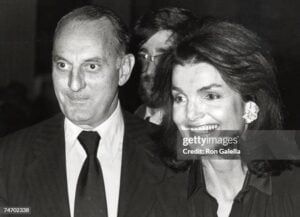
This is a true story of a legal issue faced by American royalty.
In 1978, a young man named Louis worked at the law firm of Hawkins Delafield and Wood, known for its expertise in legal issues involving municipal bonds. Louis was in the litigation department and had just finished his clerkship for Lawrence H. Cooke, the Chief Judge of the New York Court of Appeals. During his clerkship, Louis worked on cases touching on many aspects of New York law.
One of the partners at Hawkins was a man named Louis Auchincloss. “Louie”, as he was known, was a novelist. He did not seem to practice law except maybe occasionally and certainly had nothing to do with the bond practice in the firm.
Louie had heard of this young lawyer also named Louis, who had finished a clerkship in the Court of Appeals, and was presumed to have a lot of knowledge about the common law in New York. Louie would often summon Louis to his office and ask him a legal question. The young Louis was always able to give him the answer, often with some colorful explanations.
One day Louie summoned Louis to come to the office and asked him for help with a problem. Louie said, “I have a friend — you may have heard of her. Her name is Jackie Onassis; she was married to the president.” (Louie was so polite that he would not presume that anyone knew of such people). Young Louis smiled inwardly and said, Yes, Louie, I believe I have heard of her.
Louie then proceeded to explain that Jackie had written several letters to another woman having to do with a piece of jewelry. In the letter, Jackie suggested she might give the jewelry to the woman in return for a favor but then changed her mind and decided she did not want to give her the jewelry, despitr the favor that this other woman had done for Jackie. In Jackie’s view she had never made a promise but only discussed giving the jewelry to the woman
Louie asked Louis, “Is Jackie bound to that agreement?” “Does she have to give her the jewelry?” Louis responded that this was an issue that comes up may times. There was a time, said Louis to Louie, when the law required a formal promise clearly stated. However, for some time there has been case law stating that letters and statements, with no specific promise, can be patched together and considered a binding and enforcible promise.
“The law has outgrown its primitive stage of formalism when the precise word was the sovereign talisman, and every slip was fatal. It takes a broader view today. A promise may be lacking, and yet the whole writing may be ‘instinct with an obligation,’ imperfectly expressed.….”
Wood v. Lucy, Lady Duff-Gordon, 222 N.Y. 88, 91, 118 N.E. 214 (1917).
Here, the other woman had changed her position and having done some favor for Jackie, and that would be sufficient to the consideration. Consequently, Louis told Louie, I am afraid Jackie is likely to have bound herself to give the other woman the jewelry. Louie said, thank you very much…I will tell Jackie.
Young Louis left amused by Louie’s quaint manner and his circle of royal family and friends. He was also struck, as he had been before, by how kind Louie was. Louie looked every bit the patrician and spoke with elegance and care, yet he always treated Louis like royalty too.